Choppy Dollar Momentum Reintroduces Two‑Way Flows in Emerging Markets
March 31 marked an abrupt shift in safe-haven demand for the U.S. dollar, leaving forex markets more susceptible to two-way trading in the near term.

Key Points
- A broad rally across global financial markets on March 31 lifted emerging currencies like the Mexican peso and South African rand, as safe-haven demand for the U.S. dollar eased sharply.
- In USD/MXN, the broader narrative is also being shaped by domestic policy, as the Bank of Mexico’s March 26 rate weakened one of the peso’s key pillars of support.
- The result is a more active two-way market—relief rallies can still benefit currencies like the peso and rand, while renewed geopolitical stress can quickly send the dollar higher.
For much of the past year, the path in emerging market FX had been fairly consistent. High-yielding currencies like the Mexican peso and South African rand benefited from a favorable mix of carry, calmer global conditions, and improving local fundamentals, allowing them to steadily gain ground against the U.S. dollar.
That backdrop started to crack once geopolitical tensions around Iran escalated. As markets turned more defensive, the dollar slipped back into its familiar safe-haven role, and some of the earlier strength in risk-sensitive currencies began to unwind. The move was especially visible in pairs like USD/MXN and USD/ZAR, both of which turned higher as demand for safety overtook the hunt for yield.
But the story did not stay one-sided for long.
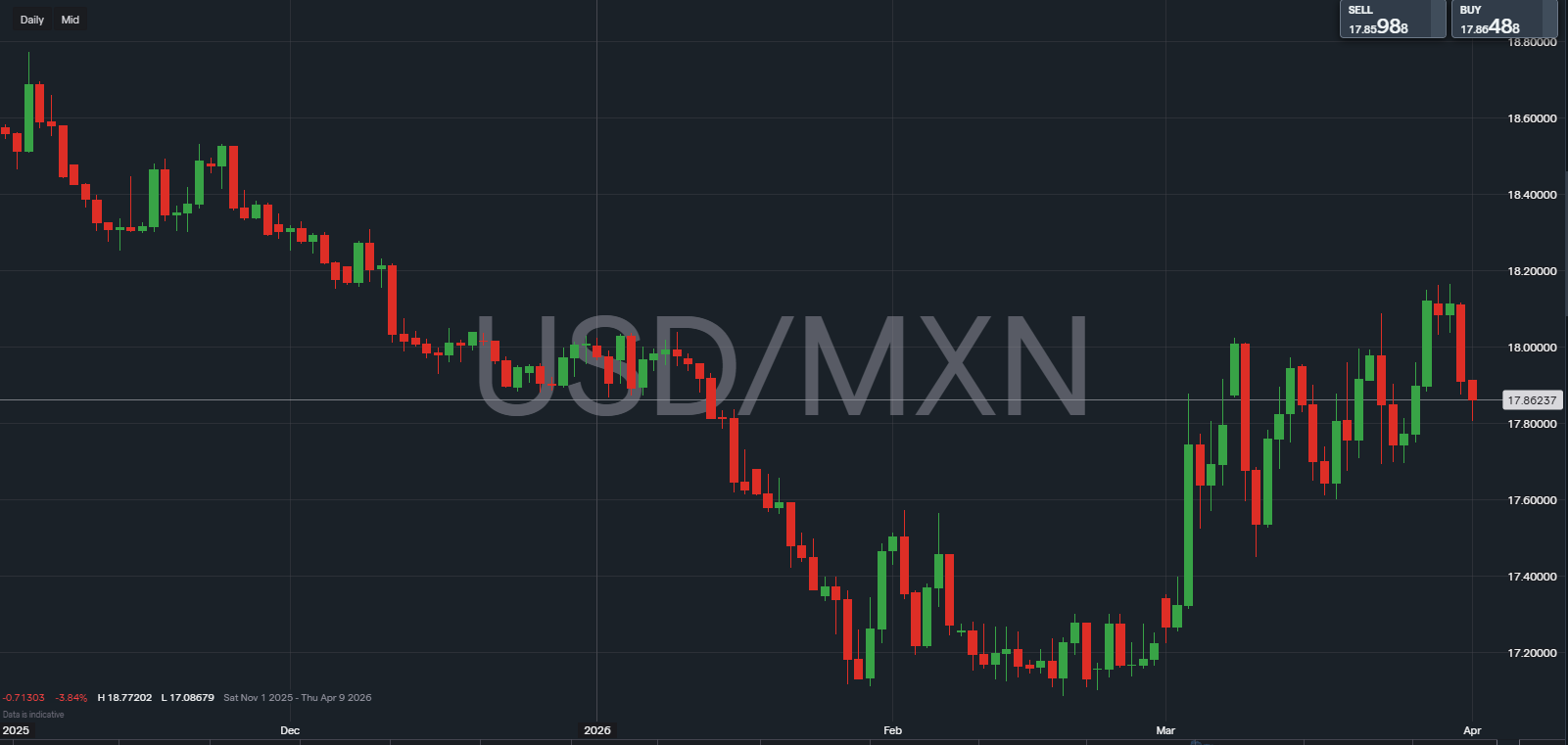
On March 31, a broad relief rally swept through global markets and reminded traders how quickly sentiment can turn in the other direction. Equities surged, the dollar lost some of its defensive bid, and emerging market currencies found support again. USD/MXN, which had recently traded above 18.10, fell back toward 17.85, while USD/ZAR also pulled lower toward 16.75.
That shift is important not because it cancels the earlier dollar strength, but because it changes the character of the market.
This no longer looks like a clean trend driven by one dominant force. It looks more like a market being pulled back and forth by competing narratives. If geopolitical stress fades, currencies like the peso and rand have room to recover further. But if the conflict intensifies again, or hopes for de-escalation prove premature, the dollar could quickly regain the upper hand.
Bank of Mexico Cuts Rates on March 26
Even with global risk sentiment driving a large share of the recent price action, domestic macro policy still matters—especially in Mexico.
That was clear on March 26, when the Bank of Mexico lowered its benchmark rate by 25 basis points to 6.75%. The decision signaled a greater willingness to support a slowing economy, but the fact that it was not unanimous also revealed how uneasy that pivot remains. Inflation is still running above target, which leaves the central bank trying to balance weaker growth against price pressures that have not fully gone away.
For the peso, the message is fairly straightforward: one of its most important supports is no longer as strong as it was. Mexico’s yield advantage helped make the peso one of the more compelling carry stories in emerging markets, but that edge naturally becomes less powerful once the easing cycle resumes.
That shift stands out even more with the Federal Reserve still on hold. As the gap between Mexican and U.S. rates begins to narrow, part of the macro foundation that had favored peso strength starts to weaken.
At the same time, this is not a simple one-way bearish story for the peso. The recent rebound in broader risk appetite has reminded markets that when sentiment improves, emerging currencies can still attract buyers. That means USD/MXN is no longer being driven by rate differentials alone.
Instead, the peso is now caught between two competing forces. On one side, lower Mexican rates make the carry trade a bit less compelling. On the other, any return of risk appetite can still provide meaningful support. The result is a market that looks less clean than it did a few months ago—and more dependent on which macro force takes the lead from one week to the next.
Key Levels to Watch in USD/MXN and USD/ZAR
The recent pullback in both USD/MXN and USD/ZAR does not necessarily mean the dollar’s rebound is over. What it does suggest is that these pairs are no longer moving in a clean, one-directional trend. Instead, they are settling into a more two-way market, where shifts in sentiment, geopolitics, and rate expectations can quickly change the tone.
In USD/MXN, that shift has been especially clear. After briefly trading above 18.10, the pair has slipped back toward 17.85, underscoring how quickly the dollar can give ground when safe-haven demand fades and broader risk appetite improves.
On the downside, the 17.40 to 17.60 area in USD/MXN now stands out as an important near-term zone. If the pair continues to drift lower, that range could act as the first meaningful test of whether the recent reversal has further room to run. Below that, the 17.10 area still marks a broader reference point tied to the peso’s earlier period of strength. Reaching those lower levels would likely require calmer geopolitical conditions, steadier risk appetite, and a more durable unwinding of the dollar’s safe-haven bid.
On the upside, the 18.00 to 18.30 zone remains the key area to watch. A move back into that range would suggest that dollar demand is rebuilding and that the market is once again leaning toward a more defensive posture. If safe-haven flows return, or if traders begin to price in additional easing from the Bank of Mexico, that upper band could come back into focus fairly quickly.
USD/MXN price history
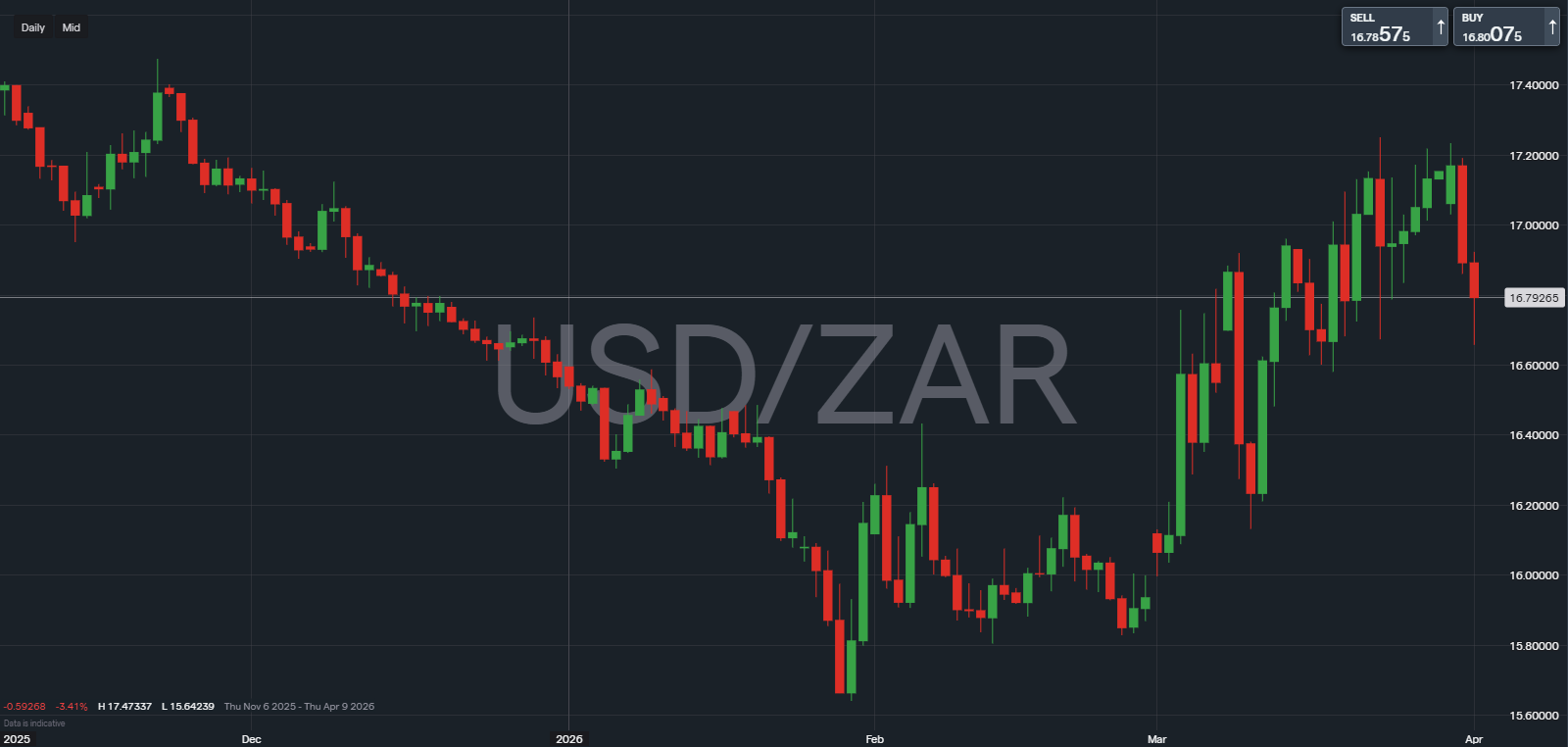
USD/ZAR tells a similar story, though in its usual more volatile fashion. After moving back above 17, the pair has retreated toward 16.75, a reminder that the rand remains highly sensitive to swings in global sentiment.
Looking ahead, 16.50 to 16.75 in USD/ZAR is the first key zone to monitor. A move below that area could open the door to a deeper retracement into the mid-16s. On the upside, a return above 17.20 to 17.35 would be worth watching if safe-haven demand returns. And in a more extreme risk-off scenario, a move back above 18 cannot be ruled out.
USD/ZAR price history
The key takeaway is that emerging market FX has moved back into a more active two-way trading environment. Equity rallies and calmer headlines can quickly lift currencies like the peso and rand, while renewed geopolitical stress can just as quickly send flows back into the dollar. That makes these pairs less about a clean trend and more about which macro catalyst hits next.
How to trade Emerging Markets
- Open an account to get started, or practice on a demo account
- Choose your forex trading platform
- Open, monitor, and close positions on EM currency pairs
Trading forex requires an account with a forex provider like tastyfx. Many traders also watch major forex pairs like EUR/USD and USD/JPY for potential opportunities based on economic events such as inflation releases or interest rate decisions. Economic events can produce more volatility for forex pairs, which can mean greater potential profits and losses as risks can increase at these times. Past performance is not indicative of future results.
You can help develop your forex trading strategies using resources like tastyfx’s YouTube channel. Our curated playlists can help you stay up to date on current markets and understanding key terms. Once your strategy is developed, you can follow the above steps to opening an account and getting started trading forex.
Your profit or loss is calculated according to your full position size. Leverage will magnify both your profits and losses. It’s important to manage your risks carefully as losses can exceed your deposit. Ensure you understand the risks and benefits associated with trading leveraged products before you start trading with them. Trade using money you’re comfortable losing.