Dollar Strength Persists vs Yen, Bucking Macro Expectations
Despite dollar weakness, the Japanese yen couldn't catch a bid in 2025 and remains near its lows for the year. Can diverging central bank policy turn things around in 2026?

Key Points:
- USD/JPY continues to favor the dollar, defying macro expectations following the Bank of Japan’s rate hike to 0.75%.
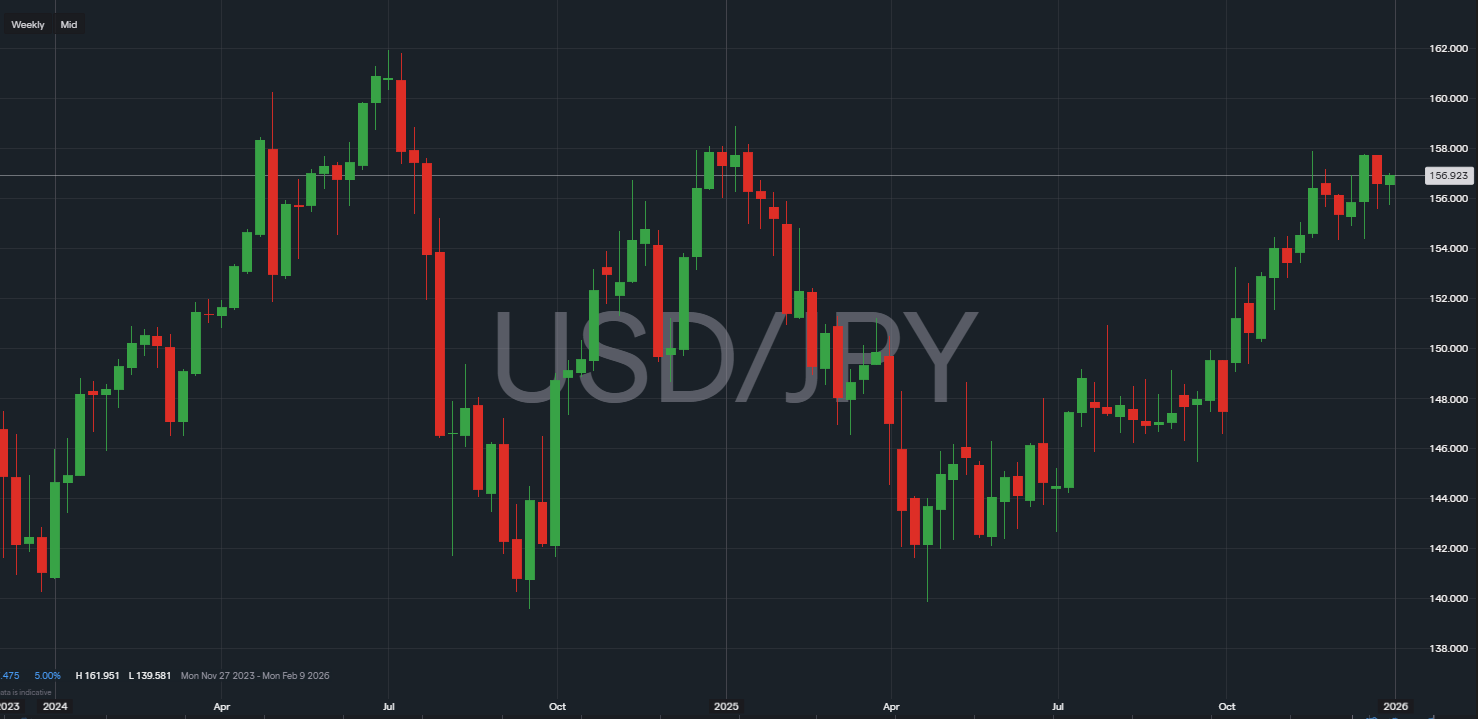
- With the pair trading near 156.90, and sitting just below its 52-week high of 158.85, the risk of BoJ intervention is growing, as policymakers monitor volatility and fundamentals.
- The next major shift in the pair may hinge on upcoming catalysts, including back-to-back central bank meetings in late January and the potential for a U.S. Supreme Court ruling on tariffs that could reshape trade dynamics.
In early 2026, sentiment around the U.S. dollar remains bearish—but USD/JPY continues to buck the trend. By most accounts, the yen should be strengthening. Japan’s central bank has begun moving away from years of ultra-loose policy, inflation has been running above target, and the interest rate gap between the U.S. and Japan is starting to narrow.
Yet despite that setup, the dollar has continued to climb against the yen, breaking with macro expectations. The divergence is becoming harder to ignore—and if dollar momentum keeps building, the Bank of Japan may be compelled to step in. Not because it’s eager to intervene, but because market forces could leave policymakers with few alternatives.
Yen Strength on Paper, Dollar Strength in Practice
At face value, the latest macro developments in USD/JPY looked like a textbook setup for yen strength.
On December 19, the Bank of Japan delivered a well-telegraphed 25-basis-point rate hike—raising its benchmark interest rate to 0.75%, the highest level in three decades. At the same time, 10-year Japanese Government Bond (JGB) yields pushed above 2% for the first time since 1999. Meanwhile, a dovish official is expected to take the helm at the Federal Reserve. On paper, this combination should have narrowed the U.S.–Japan yield spread and tilted momentum toward a stronger yen.
But the market had other ideas. Despite the headline hike, the yen failed to gain traction—USD/JPY climbed back above 157 in the wake of the December BOJ meeting. The message? It wasn’t the rate move that mattered—it was the tone. The BOJ may be normalizing policy, but its messaging remained cautious. Real rates are still deep in negative territory. The economy is fragile. And core inflation is expected to moderate in 2026. Rather than signaling urgency, the BOJ looked like it was buying time.
The result has followed a familiar pattern: rate hikes that make headlines, but don’t change the narrative. Even as Japanese yields climb to multi-decade highs, traders continue to discount the likelihood of a sustained tightening cycle. Markets don’t see a central bank in motion—they see one inching forward with the brakes still half-on.
And until Japan’s policy stance shifts from cautious to committed, USD/JPY may remain tilted to the upside—even in a macro environment that would normally favor the yen.
Market Focus Shifts to January
With the BOJ’s latest rate hike now priced in, the next inflection point arrives relatively quickly.
The Bank of Japan meets again on January 22–23, followed closely by the Fed on January 27–28. That sequencing keeps USD/JPY highly sensitive to tone and messaging. And right now, the tone from Tokyo still leans cautious. Unless that tone hardens, the yen will struggle to attract buyers—or to break the grip of carry-fueled flows that are seemingly pushing USD/JPY higher.
On the U.S. side, softer CPI data has reopened the conversation around rate cuts. Fed funds futures currently assign an 85% probability that the Fed holds steady at its January meeting—but as traders saw in December, expectations can flip quickly. A weak jobs print, or a dovish speech, and the market’s outlook could shift dramatically. For now, however, the carry trade remains in place. Unless one of the central banks pivots in material fashion, monetary policy is likely to reinforce current trends rather than disrupt them.
The above suggests that trade policy could be a near-term catalyst.
A Supreme Court reversal of the Trump administration’s tariffs could spark a fast-moving “risk-on” rally—effectively the opposite of what was observed last spring. At that time, the tariff rollout drove USD/JPY from 150 to 140 in under two weeks. Reversing those policies could therefore reflate risk assets, weaken the yen, and push USD/JPY higher as part of a broader market snapback.
Bank of Japan Intervention Could Boost the Yen
From a contrarian perspective, USD/JPY is approaching more than just technical resistance—it’s nearing a level that could prompt real action. Trading around 156.90, the pair sits just below its 52-week high near 158.85—a threshold that previously drew verbal warnings from Japanese officials. With the dollar continuing to defy macro logic, this “red line” could mark the point where market momentum collides with policy pressure.
While the Bank of Japan recently raised its policy rate to 0.75%—the highest in three decades—the move hasn’t been enough to reverse yen weakness. Finance Minister Satsuki Katayama has already stated that current FX levels may not reflect economic fundamentals, signaling that intervention remains on the table.
Japan last intervened in July 2024, when USD/JPY surged just below 162—the highest reading in the pair since 1986. That history looms large, especially with policymakers once again warning of potential action. According to the Tokyo–Washington exchange rate framework, Japan would need to demonstrate that market moves are either excessively volatile, disorderly, or disconnected from fundamentals to justify direct intervention.
So far, those thresholds haven’t been breached. But if USD/JPY breaks through the 52-week high and volatility picks up, intervention may become extremely likely (if history is to repeat itself). In that scenario, the bank's desired effect would be a direct move higher for the yen against other major currencies. Even a credible warning shot from Japanese officials could be enough to spark a pullback in the pair.