Dollar-yen consolidating near January lows ahead of key data releases
USD/JPY hovers near lows as traders eye potential breakouts on upcoming economic catalysts amid thin liquidity.


Japanese Yen bottom might be in after traders shift bullish following elections
Trying to call a bottom in the Japanese Yen turned out to be an exercise in futility in the second half of 2025, but it now appears that a bottom might be in. The Yen is trading near its January highs against the dollar, which marked the strongest levels for the currency since October.
While Japanese markets remain open, trading volumes for the currency during the Asian hours could be impacted by the Lunar New Year over the next several weeks. The question facing Yen traders is what exactly is moving the market: fundamentals or political implications? It’s likely a bit of both, for now at least.
Late last month, Japan’s Prime Minister Sanae Takaichi warned the market that Japan would defend the currency without implicitly mentioning the Yen. USD/JPY fell over 1% following the comments. Speculation about a joint intervention involving the United States added to the Yen’s strength. Last week saw another strong showing for the Japanese currency following a landslide election victory by Takaichi’s Liberal Democrat Party (LDP). USD/JPY fell 2.9% last week, the largest weekly decline since November 2024.
Still, data out of Japan this week showed that Japan’s economy rose only 0.2% on an annualized basis in the October to December quarter. The disappointing figure cast doubt over the Bank of Japan’s ability to tighten monetary policy in March, with traders now seeing an April rate hike as the more likely outcome. Overnight index swaps are pricing a nearly 70% chance for an April hike, which is down slightly from about 73% the week prior. Rates in Japan are at their highest level in 30 years at 0.75%, although that still lags well behind those of its major peers. Meanwhile, the U.S. isn’t expected to cut rates until June, leaving plenty of time for economic conditions to shift.
The election results removed uncertainty from the market, which benefited the Yen even though many initially saw the victory as a negative. Now, economic reality is setting in, and traders realize that Japan faces a challenging environment where slow growth could complicate policy tightening expectations.
Still, hedge funds appear to be betting on more Yen strength, according to a report from Bloomberg. The report cites an increase in USD/JPY put contracts, with about a 50% increase versus call options last Wednesday, citing data from the Depository Trust & Clearing Corporation. To revisit the question of fundamentals or political policy driving the Yen, we can assume that as we move away from the recent elections, fundamentals will once again overtake price action. However, it also seems to be a bit of a positioning shift at the moment.
Japanese inflation, US GDP and PCE data are set to release later this week. Find out when: Economic calendar
USD/JPY Daily Price History
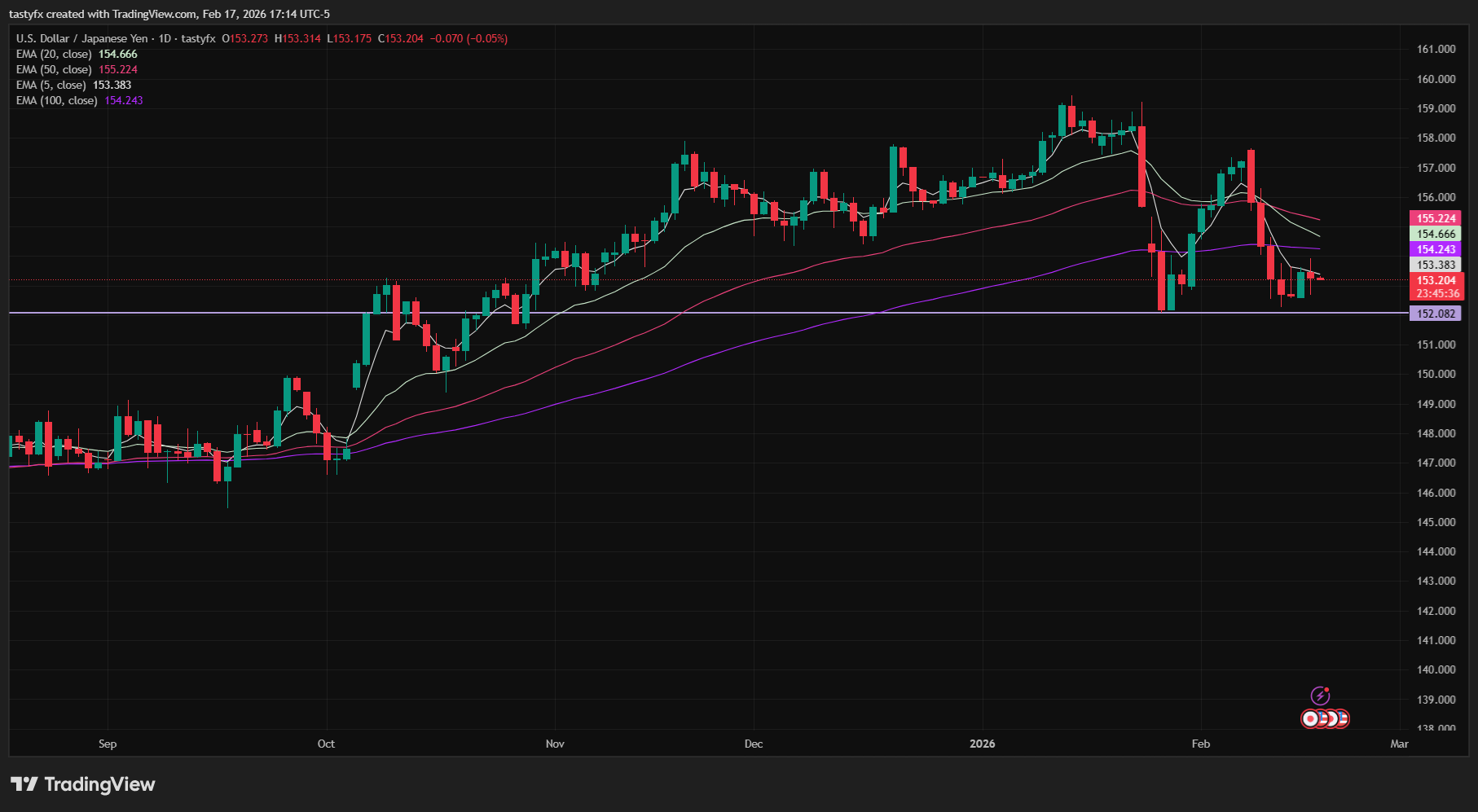
USD/JPY failed to break below late January levels earlier this month, but prices remain near those lows after several days of consolidation. Today’s intraday price action was capped by the falling 9-day exponential moving average (EMA).
A retracement higher is possible, but the last one that started in late January was quickly sold. The best case scenario for USD/JPY bears would be a break of horizontal support from the January low at 152.091, which would open up a possible path to the psychologically imposing 150 level.
Trading forex requires an account with a forex provider like tastyfx. It’s important to manage your risks carefully as losses can exceed your deposit. Ensure you understand the risks and benefits associated with trading leveraged products before you start trading with them.