Emerging-Market Tailwinds Continue to Support the Mexican Peso
The peso’s comeback offers a clear example of how emerging-market trades can outperform when the dollar weakens.

Key Points
- The Mexican peso enters 2026 on firm footing, extending a recovery that began in early 2025, and pushing USD/MXN back toward multi-year highs.
- The peso’s strength has been driven by attractive interest-rate differentials, a softer U.S. dollar, and improving risk appetite across emerging-market currencies.
- With USD/MXN near 52-week highs, central-bank guidance and dollar sentiment are critical for the pair’s near-term direction.
The Mexican peso enters 2026 with renewed momentum, trading near its strongest levels in years after a sharp recovery over the past twelve months. Improving global conditions and renewed demand for higher-yielding emerging-market currencies have helped restore confidence following a period of pronounced dollar strength.
Now entering 2026 near its strongest levels in years, USD/MXN reflects not just a rebound, but a broader shift in how markets are pricing risk, carry, and policy credibility. Today we assess the near-term outlook for USD/MXN and how broader emerging-market dynamics continue to shape this trade.
USD/MXN Price History
Peso Strength Carries Into 2026
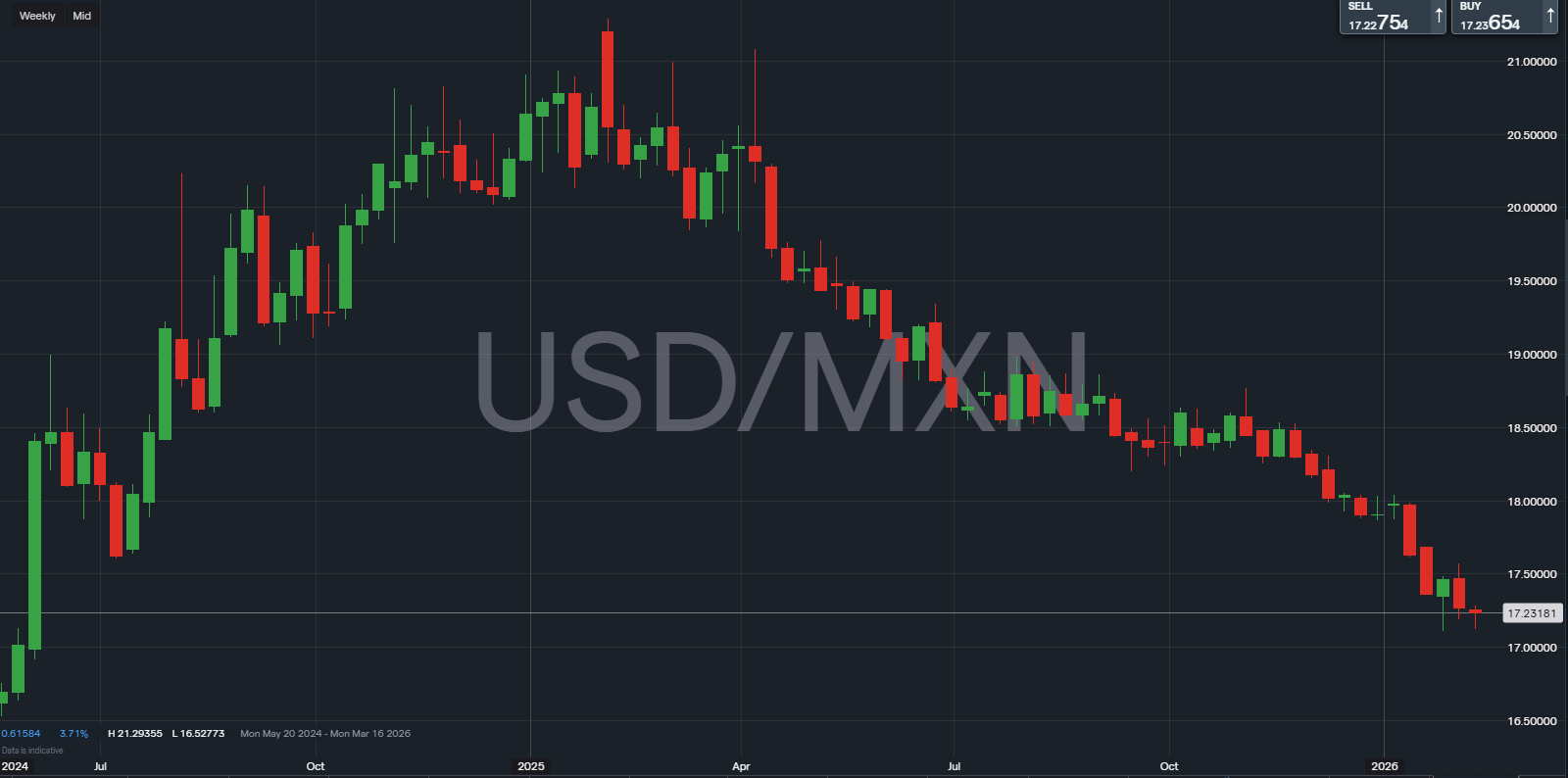
The Mexican peso’s strength has carried over decisively from 2025 into the opening weeks of 2026. Since the start of the year, USD/MXN has fallen from roughly 18.00 to around 17.20, representing a ~4.3% appreciation in the peso over just a few weeks.
That move places the peso near the strongest levels seen over the past year. Over the last 52 weeks, USD/MXN’s best level was approximately 17.10, meaning the exchange rate continues to trade just shy of that high-water mark. From a shorter-term perspective, the peso is operating near the upper end of its recent range rather than merely rebounding from prior weakness.
Looking further back adds important context. Over the past five years, the peso’s strongest point came in spring 2024, when USD/MXN briefly traded near 16.40. That strength proved short-lived. From mid-2024 into early 2025, the U.S. dollar climbed steadily, pushing USD/MXN above 20.00 and marking one of the peso’s weaker stretches of the cycle.
Since the start of 2025, that trend has reversed. The peso has staged a sustained recovery, clawing back most of the dollar’s prior gains. With USD/MXN now hovering near 17.20, the peso is once again within reach of its strongest levels of the past five years—highlighting how much ground it has regained in a relatively short period of time.
Near-Term Levels and Policy Signals to Watch
Looking ahead, the peso’s trajectory remains closely tied to central-bank signaling and broader dollar trends. At its February 5 meeting, Banco de México voted unanimously to hold the benchmark rate at 7.00%, pausing after twelve consecutive rate cuts. The decision was widely expected, and while the peso initially softened modestly, USD/MXN quickly rebounded—returning toward 17.25–17.30, suggesting the market viewed the outcome as broadly neutral.
More notable was Banxico’s updated guidance. The central bank pushed out its timeline for inflation to return to its 3% target until the second quarter of 2027, while revising inflation forecasts higher for the remainder of 2026. Policymakers cited persistent core inflation, cost pressures, currency risks, and geopolitical uncertainty as key challenges—reinforcing a cautious stance even as Mexico’s economic growth outlook remains subdued.
Attention now turns to Banxico’s March 26 meeting and the March 17–18 decision from the Federal Reserve. With USD/MXN trading near recent highs, the outlook remains two-sided. If the dollar continues to soften and risk sentiment holds steady, the peso could extend its gains, potentially pushing USD/MXN closer to 17.00. On the other hand, stronger U.S. data or a rebound in the dollar could pull the exchange rate back toward 18.00, even without a meaningful shift in Mexico-specific fundamentals.
With policy expectations finely balanced, small changes in central-bank messaging and dollar trends could have an outsized impact on USD/MXN through the remainder of Q1.
Trading Emerging-Market Currencies
In the foreign exchange market, emerging-market currencies typically refer to currencies issued by developing or fast-growing economies that sit outside the traditional G10 (the group of major, highly liquid currencies such as the U.S. dollar, euro, yen, and British pound).
These currencies tend to offer higher interest rates and greater yield potential, but they also carry higher sensitivity to global capital flows, policy shifts, and changes in risk sentiment. As a result, they can deliver strong gains when conditions are favorable, but can also experience sharp volatility when the trading environment sours.
Movements in emerging-market currencies are often driven by where investors can earn yield and how comfortable they are taking risk. When the dollar weakens and global conditions stabilize, capital typically flows toward higher-yielding markets. The Mexican peso’s recent performance reflects that dynamic clearly.
A central driver of the peso’s strength has been the carry trade, where investors earn returns by holding higher-yielding currencies. Even as Mexico began cautiously lowering interest rates, its yields remained high relative to other currencies, keeping the peso attractive for income-focused strategies. As long as global conditions stayed relatively stable, that yield advantage encouraged investors to maintain peso exposure, providing steady support without relying on speculative risk-taking.
The broader dollar environment has also played an important role. When the U.S. dollar strengthens, it typically weighs on higher-yielding currencies by drawing capital back toward U.S. assets. That pressure eased in 2025 as the dollar lost value and U.S. rate expectations became less one-sided, allowing emerging-market currencies to stabilize. As a result, part of the peso’s recovery reflected a more supportive global backdrop rather than a sudden improvement in Mexico’s domestic fundamentals.
Policy credibility and market positioning have also reinforced the peso’s move. Mexico’s track record of disciplined monetary policy and relatively orthodox macro management has helped preserve investor confidence during periods of global uncertainty. As conditions improved and the peso began to strengthen, investors who had been positioned for further weakness were forced to unwind short positions, adding momentum to the rally.
Taken together, the continued support from carry, dollar dynamics, risk sentiment, and policy credibility has extended the peso’s advance into early 2026.
How to trade the Mexican peso
- Open an account to get started, or practice on a demo account
- Choose your forex trading platform
- Open, monitor, and close positions on USD/MXN
Trading forex requires an account with a forex provider like tastyfx. Many traders also watch major forex pairs like EUR/USD and USD/JPY for potential opportunities based on economic events such as inflation releases or interest rate decisions. Economic events can produce more volatility for forex pairs, which can mean greater potential profits and losses as risks can increase at these times. Past performance is not indicative of future results.
You can help develop your forex trading strategies using resources like tastyfx’s YouTube channel. Our curated playlists can help you stay up to date on current markets and understanding key terms. Once your strategy is developed, you can follow the above steps to opening an account and getting started trading forex.
Your profit or loss is calculated according to your full position size. Leverage will magnify both your profits and losses. It’s important to manage your risks carefully as losses can exceed your deposit. Ensure you understand the risks and benefits associated with trading leveraged products before you start trading with them. Trade using money you’re comfortable losing.