Intervention Risk in Focus After Sharp Selloff in USD/JPY
USD/JPY plunged on rate check reports signaling possible U.S.-Japan coordinated intervention. Here's what it means and what to watch this week.

Key Points
- USD/JPY reversed sharply on January 23, falling from near 159 to 155.70 after intervention speculation gained traction. By Sunday evening, the pair had dropped to 154.20
- There’s rising speculation that Japanese authorities may act soon—potentially with U.S. support—to stabilize the yen.
- Another key catalyst is on deck, as the Federal Reserve prepares to deliver its latest policy decision on January 28.
The forex market got a jolt on Friday, January 23, when USD/JPY suddenly reversed course at the end of the trading day and dropped hard—falling from around 158.20 to as low as 155.70 in a matter of hours. That slide marked one of the largest single-day moves in about six months, snapping a steady uptrend and forcing traders to reassess recent activity in the pair. As of Monday morning, the rate had slipped further, trading closer to 154.20.
The move broke a weeks-long trend of dollar strength in USD/JPY. Prior to January 23, the U.S. dollar had been steadily grinding higher against the yen, climbing from the 156 area in late December to nearly 159 on Thursday—just shy of the 52-week high of 159.40. That rally extended a broader trend that began back in April, when USD/JPY bottomed near 140. Since then, dollar strength and yen weakness have defined the pair, fueled by divergent central bank policies and resilient U.S. economic data.
USD/JPY Price History
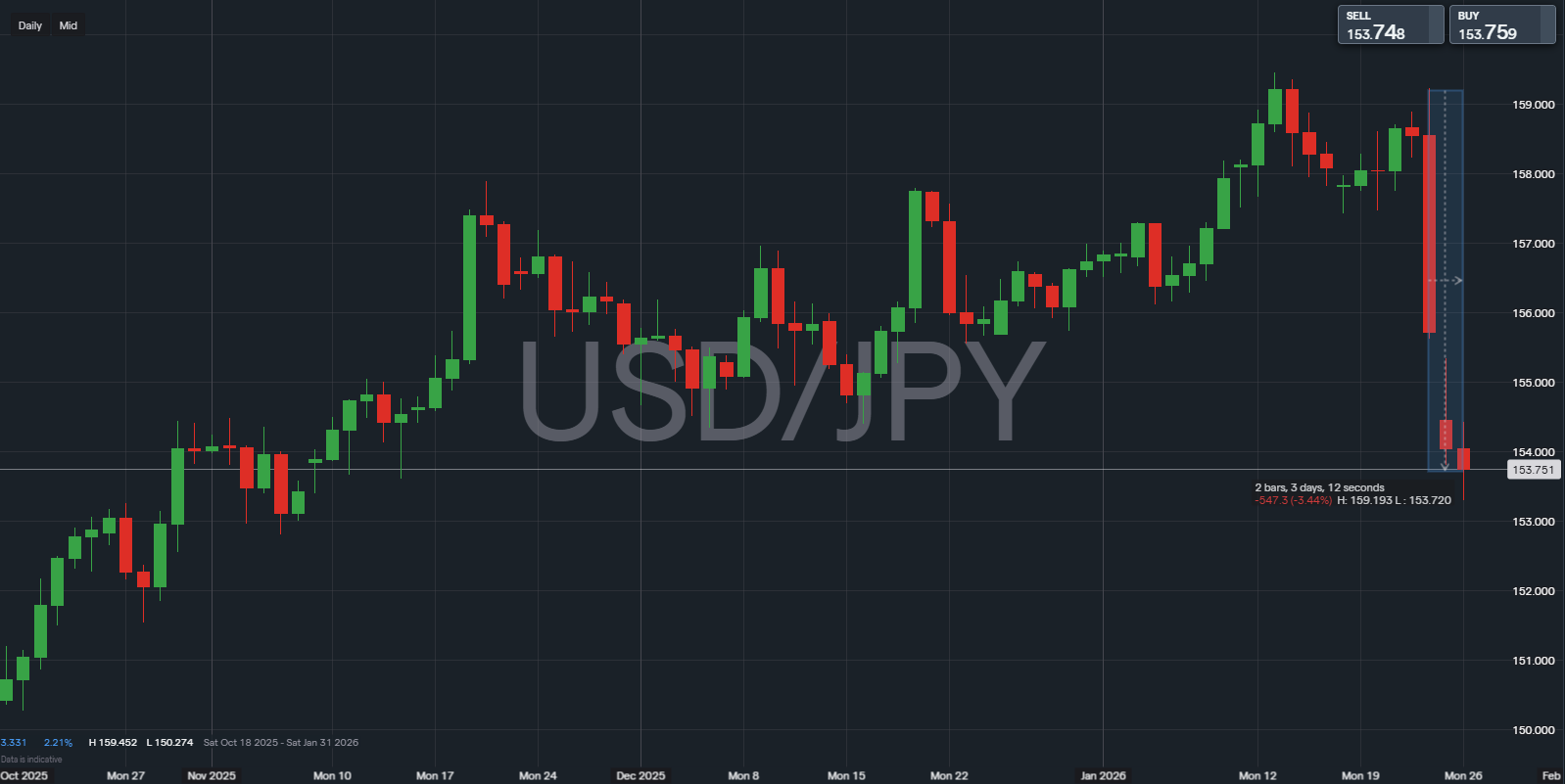
But Friday’s reversal wasn’t entirely out of the blue. As we noted earlier this month, USD/JPY was already pushing into a zone that many in the market viewed as a red line for Japanese policymakers.
The level itself—just below 159—was significant, brushing up against prior intervention points and approaching the pair’s 52-week high. But so was the timing: the Bank of Japan (BoJ) was concluding a critical policy meeting the very same day, with expectations rising that officials might sharpen their tone or signal greater discomfort with yen weakness.
With the BoJ meeting underway and USD/JPY trading near intervention-sensitive highs, the setup left the pair highly vulnerable to a sentiment shift—something that has now played out decisively, as the rate has dropped more than four points in just a few days.
BoJ Holds Rates Steady, but Intervention Risk Takes Center Stage
The Bank of Japan concluded its two-day policy meeting on January 23 with no changes to its benchmark interest rate, holding steady at 0.75%—a decision widely anticipated by markets. However, BoJ officials left open the possibility of additional rate hikes, citing persistent inflation pressures and renewed fiscal stimulus ahead of next month’s snap election.
Amid the policy announcement, the yen initially came under pressure, slipping to 159 against the U.S. dollar during Tokyo trading. But that weakness quickly gave way to a sharp reversal. Later in the global session, the yen staged its strongest rally in months, triggering renewed speculation that Japanese authorities may be preparing to intervene in the currency market.
The first signal came from Japan’s Ministry of Finance, where officials repeated their commitment to taking “decisive action” against speculative or disorderly moves in the yen. That was followed by reports that the Federal Reserve Bank of New York had conducted a rate check on USD/JPY—an uncommon move that has historically preceded coordinated foreign exchange intervention between the U.S. and Japan.
Over the weekend, speculation intensified that Japanese officials may be preparing to intervene—possibly with support from the U.S. Treasury. While no formal action has been confirmed, the combination of a rate check by the New York Fed and reports of high-level coordination between U.S. and Japanese officials suggests that both governments are increasingly concerned about the yen’s persistent weakness and growing volatility in Japanese markets.
The stakes extend far beyond the currency itself. The yen carry trade is one of the largest macro funding strategies in global finance, with the Bank for International Settlements estimating its size at roughly $260 billion. Even a modest and sustained rise in the yen could force a rapid unwind of these positions—injecting volatility into global markets and triggering ripple effects across equities, bonds, and other risk-sensitive assets.
What makes this episode different from past intervention scares is the apparent U.S. involvement. When Japan intervenes unilaterally, the market tends to fade it — traders have learned to treat solo intervention as a selling opportunity since the underlying rate differential hasn't changed. But a rate check conducted by the NY Fed at Treasury's direction suggests the U.S. isn't just tolerating Japanese action, they may be actively coordinating. Fighting the BoJ is one thing. Fighting the BoJ with the Fed and Treasury behind them is a much lonelier trade. The U.S. has its own reasons to prefer a stronger yen here: persistent yen weakness makes Japanese exports more competitive against American goods, which cuts against the administration's tariff and trade rebalancing agenda. And after August's carry trade unwind showed how disruptive a disorderly yen spike can be, both governments may prefer to engineer a controlled move now rather than risk a violent squeeze later.
Fed Decision Scheduled for January 28
The Federal Reserve is scheduled to meet on January 27–28, with markets currently expecting them to hold rates steady. After several rate cuts in late 2025, Fed officials appear content to pause and monitor incoming data. That stability may reduce the role of U.S. policy as a near-term driver of dollar-yen, at least for now.
In contrast, Japan is showing signs of greater urgency. Last week’s yen rally wasn’t just about the BoJ holding rates—it was about the broader landscape. Verbal warnings, rate check chatter, and speculation of U.S. involvement have raised the stakes. Traders are no longer just watching for policy divergence; they’re watching for intervention.
That shift matters for the carry trade. For much of 2025, long USD/JPY positions were powered by calm central banks and wide rate differentials. But when intervention risk enters the picture, that stability can evaporate fast. The Fed may be standing still, but Japan isn’t—and that reality could define the next leg of the USD/JPY trade.