Is NZD/USD on the Verge of a Policy-Driven Breakout?
NZD/USD has been stuck in a tight range, but 2026 could bring a breakout. With the Fed and RBNZ easing at different speeds, policy divergence may finally give this pair some direction in the coming months.
.jpg?format=pjpg&auto=webp&quality=90&width=820&disable=upscale)

Key Points:
- NZD/USD has remained confined to a tight range, but conditions could shift in 2026, opening the door for a breakout.
- Both the Federal Reserve and the Reserve Bank of New Zealand have entered easing cycles, but with differing speeds and tones—raising the potential for policy misalignment that could drive directional movement.
- With key rate decisions on deck in January and February, NZD/USD may soon offer a more compelling setup.
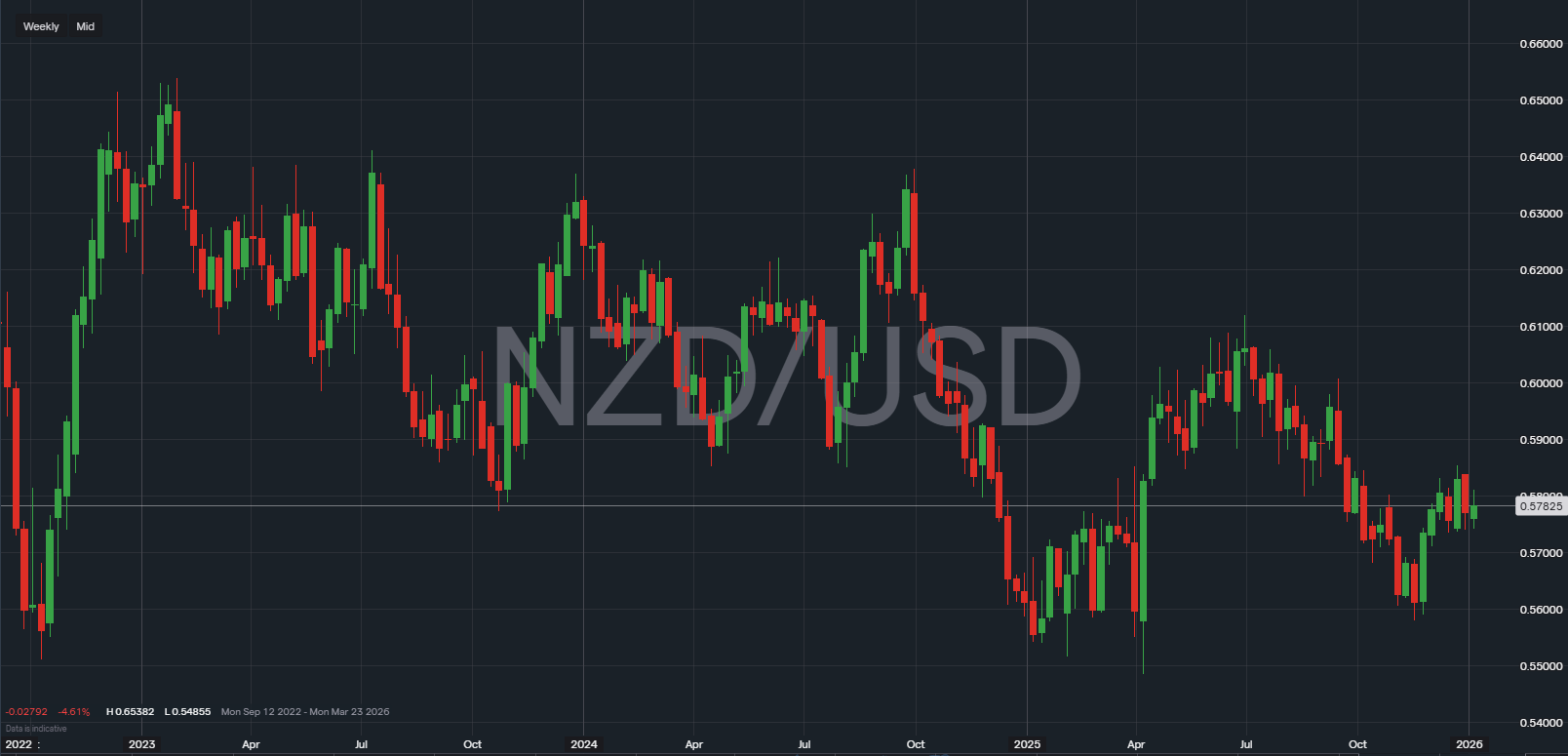
For traders focused on the Australia–New Zealand region, NZD/USD is one worth watching in early 2026. Currently, the pair trades near 0.5800—roughly in the middle of its 52-week range (0.54 to 0.61). Over the past month, however, it’s hugged a relatively tight band between 0.5750 and 0.5850.
But take a step back, and a more pronounced trend comes into focus. Since peaking around 0.7400 in 2021, the New Zealand dollar has steadily weakened against the U.S. dollar—dropping nearly 20% over five years. And that longer-term arc could help shape the pair’s direction as 2026 unfolds.
NZD/USD weekly price history
Similar Easing Cycles, But Not the Same Messaging
At first glance, the recent stability in NZD/USD—trading in a relatively tight range over the last month—might suggest a sense of balance. But that steadiness masks a more complex dynamic: a currency pair that’s navigating between two central banks which are both easing policy, but at different speeds and with contrasting tones.
Both the Reserve Bank of New Zealand (RBNZ) and the Federal Reserve have eased policy in recent months. But the pace and tone have differed. The RBNZ has moved swiftly, cutting its benchmark rate from 5.50% to 2.25% since July 2024, including three back-to-back cuts in August, October, and November. Officials have pointed to a softening economic outlook, fading inflation pressures, and a need to unwind the effects of an aggressive hiking cycle.
The Fed, on the other hand, has taken a more measured path. Since mid-2024, it’s trimmed its target range from 5.25%–5.50% to 3.50%–3.75%, with 25-basis-point cuts at each of its last three meetings. However, messaging has remained cautious, with less urgency to accommodate the American economy.
Meanwhile, long-end yields have moved higher in both economies—part of what’s helped anchor the currency pair. In New Zealand, 10-year government bond yields have climbed from 4.00% to 4.40% since early November. In the U.S., 10-year Treasury yields have risen from 4.00% to 4.20% over roughly the same period. With that rebound in rates happening in parallel, it's no surprise NZD/USD has held within its recent range.
Policy Divergence Could Spark a Breakout
Still, alignment in long-end yields doesn’t guarantee continued calm. Even as 10-year rates in both the U.S. and New Zealand have moved in parallel—helping to keep NZD/USD range-bound—policy divergence remains a live risk.
The relative calm in yields may reflect market expectations, but actual decisions from central banks could quickly shift the narrative and reintroduce volatility. The Fed meets on January 27–28, followed by the RBNZ on February 18. Futures markets currently price in an 83% chance that the Fed holds steady. Whether the RBNZ pauses—or opts for another cut—should therefore help determine the pair’s next leg.
If the Fed stays on hold while the RBNZ delivers another rate cut, dollar strength could resume—extending the longer-term trend. Alternatively, if both central banks hold steady, NZD/USD may remain confined to its current range until the next major policy shift or external catalyst emerges.
Either way, the potential for policy misalignment is rising. And any fresh asymmetry could set the stage for a more attractive directional setup in H1 2026.
Trading forex requires an account with a forex provider like tastyfx. It’s important to manage your risks carefully as losses can exceed your deposit. Ensure you understand the risks and benefits associated with trading leveraged products before you start trading with them.