USD/JPY Volatility Persists as Safe Haven Demand and Intervention Risk Collide
Recent volatility in USD/JPY has helped clarify the levels that matter—and the risks that come with them.


Key Points
- USD/JPY turned sharply higher after the February 28 escalation in the Iran conflict revived safe-haven demand for the U.S. dollar and pushed the pair back toward the upper end of its range.
- That rally briefly reversed after the Bank of Japan kept the possibility of an April rate hike alive, while renewed intervention threats from Tokyo helped pull USD/JPY back down toward 157.60.
- However, on March 23, President Trump indicated that talks were underway with Iranian officials, weighing on the dollar as safe-haven demand eased and pulling USD/JPY back toward 158.50.
- The result is a volatile two-way market, with geopolitical support continuing to underpin the dollar even as rising Japanese policy risk keeps the threat of another sharp reversal firmly in play.
USD/JPY Price History
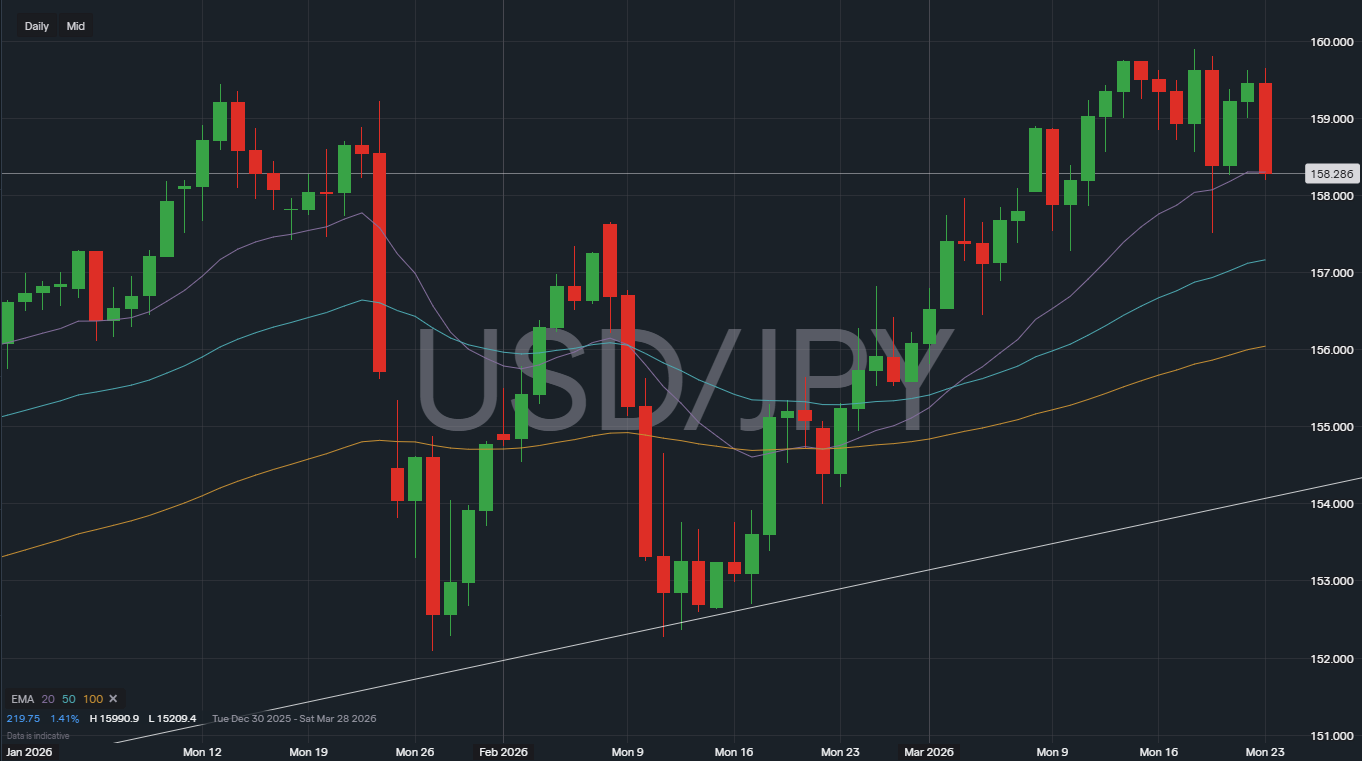
Volatility continues to define USD/JPY in 2026, but the story has evolved. Earlier in the year, the pair’s surge above 159 revived fears that Japanese authorities could step in to slow further yen weakness. That helped spark a sharp reversal lower and reinforced the idea that, once USD/JPY pushes into politically sensitive territory, momentum can flip quickly.
More recently, the trade swung back the other way. The February 28 escalation in the Iran conflict revived safe-haven demand for the U.S. dollar and helped drive USD/JPY back toward the upper end of its range. It was another reminder that this pair remains highly sensitive to geopolitical shocks and broader risk sentiment, not just central bank policy.
And once again, that rally reversed. The Bank of Japan left rates unchanged, but the market interpreted the decision as keeping the possibility of an April rate hike alive. At the same time, renewed warnings from Japanese officials over excessive currency volatility pushed intervention risk back into focus. Together, those developments helped push USD/JPY back toward 157-158.
On March 23, reports that talks were underway with Iranian officials took some of the safe-haven bid out of the dollar. And that is exactly the kind of back-and-forth that has come to define USD/JPY this year. This is not a market trending cleanly in one direction. It is a volatile, headline-sensitive trade where dollar strength and yen policy support continue to compete for control.
USD/JPY: Key Levels to Watch Now
Recent price action has made one thing clear: the key levels in USD/JPY are being shaped just as much by headlines as by technicals. The push back toward 159, followed by the pullback after news of talks with Iran, reinforces how sensitive the pair remains to shifts in safe-haven demand and Japanese policy risk.
The upper end of the range remains the clearest pressure point. Even with USD/JPY backing off slightly, the recent move toward 159 confirmed that this area still carries weight—not just technically, but politically. Once the pair starts pressing into the high-159s, the focus shifts quickly from momentum to policy. That is where intervention chatter tends to intensify, and where long-dollar positioning becomes more vulnerable to sharp reversals if Japanese officials respond more forcefully.
On the downside, the focus now sits just below current levels. With USD/JPY trading closer to 158.60, the 157 to 158 zone remains the most relevant near-term support area. That region already acted as a stabilization point during the recent pullback, and it now serves as the first level to watch if the latest loss of momentum—driven in part by easing safe-haven demand—continues.
If yen strength reemerges—whether because April hike expectations build further, safe-haven demand for the dollar continues to fade, or Tokyo sharpens its intervention language—a deeper retracement could unfold, with the mid-155s becoming the next level to watch.
Below that, the old 152–153 zone still matters as a broader structural reference point. But for now, the market’s key battleground sits much closer to spot, with 157–158 acting as support and the upper-159 area remaining the zone most likely to trigger the next volatility event.
Why the Two-Way Trade Is Still in Play
If the recent sequence of moves has made anything clear, it’s that USD/JPY is not settling into a trend. The pair has swung sharply in both directions— higher on safe-haven demand and lower on Bank of Japan expectations, intervention risk, and today’s reports of talks with Iran taking some of the safe-haven bid out of the dollar. That is the broader message: this remains a market defined by reversals, not sustained direction.
For investors, that has direct implications. The dollar side of the trade no longer looks as straightforward as it did during the latest push toward 159. If talks continue and tensions begin to ease, the safe-haven demand that helped drive that move may continue to fade, making it harder for USD/JPY to extend higher on geopolitical momentum alone.
At the same time, the yen side of the equation remains firmly in play. The Bank of Japan has kept the door open to policy normalization, and intervention risk from Tokyo continues to hang over the upper end of the range. In a market that had grown accustomed to static Japanese policy, those risks now carry more weight—especially if dollar support begins to soften.
That said, the upside case for the dollar has not disappeared. If talks break down or tensions re-escalate, safe-haven demand could return quickly and push USD/JPY back toward the highs.
That is what keeps this a two-way trade. USD/JPY is still being pulled between shifting geopolitical sentiment and evolving Japanese policy risk, leaving investors with a market where direction can change quickly—and where both sides of the trade still need to be respected.
How to trade USD/JPY
- Open an account to get started, or practice on a demo account
- Choose your forex trading platform
- Open, monitor, and close positions on USD/JPY
Trading forex requires an account with a forex provider like tastyfx. Many traders also watch major forex pairs like EUR/USD and USD/JPY for potential opportunities based on economic events such as inflation releases or interest rate decisions. Economic events can produce more volatility for forex pairs, which can mean greater potential profits and losses as risks can increase at these times.
You can help develop your forex trading strategies using resources like tastyfx’s YouTube channel. Our curated playlists can help you stay up to date on current markets and understanding key terms. Once your strategy is developed, you can follow the above steps to opening an account and getting started trading forex.
Your profit or loss is calculated according to your full position size. Leverage will magnify both your profits and losses. It’s important to manage your risks carefully as losses can exceed your deposit. Ensure you understand the risks and benefits associated with trading leveraged products before you start trading with them. Trade using money you’re comfortable losing.