Why the Euro’s Tailwinds May Extend Into 2026
EUR/USD continues to chop into yearend after posting an impressive gain in 2025. Heading into 2026, what are the fundamental drivers that could support the euro further?


Key Points:
- The U.S. dollar enters early 2026 under pressure, with economic uncertainty, trade risks, and questions around Fed leadership weighing on sentiment.
- As a result, momentum in EUR/USD appears tilted toward the euro, supported by a more constructive eurozone macro backdrop.
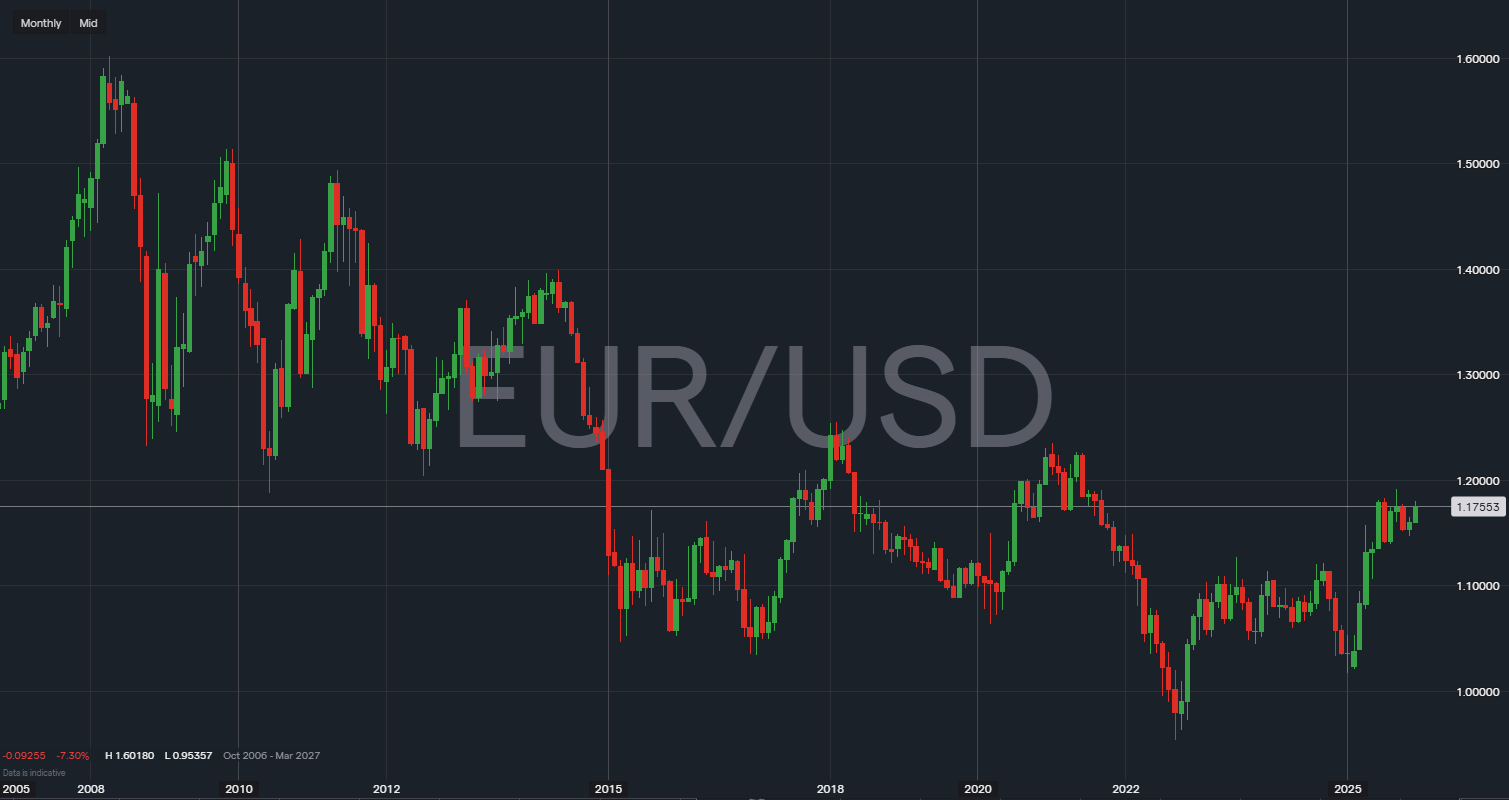
- With EUR/USD consolidating near 1.18, the near-term focus is on whether upcoming macro and policy catalysts can drive a move toward 1.20.
Dollar weakness was a theme early in 2025, but in the second half of the year, the greenback traded in more rangebound fashion. After peaking near 110, the DXY has mostly held between 97 and 100 since summer.
Looking into early 2026, negative sentiment could persist. The U.S. economy is on unstable footing, and a potential leadership shift at the Fed may tilt policy even more dovish. For now, that backdrop looks like it could continue providing support for the euro.
Today, we look at what shaped dollar performance in 2025—and why further softness may lie ahead, especially versus its European counterpart.
Where the Dollar Stands After a Turbulent 2025
The U.S. dollar entered 2025 with the wind at its sails, pressing the top of its five-year range and briefly topping 110 in mid-January. That strength didn’t last. A fresh wave of American tariffs quickly changed the macro backdrop, sending the DXY below 100 by early spring, and as low as 96 during the peak of “Liberation Day” volatility. Since then, the dollar has largely stalled, oscillating in a narrow 97–100 range.
Policy has been a quiet but persistent headwind.
After holding rates steady through the first half of the year, the Federal Reserve delivered three rate cuts in the second half, totaling 75 basis points. Those moves didn’t trigger a dollar breakdown, but they undoubtedly capped upside potential in the greenback. U.S. trade policy has added further friction, with protectionist measures reviving concerns around growth, tariff retaliation, and capital flows.
That’s why a Supreme Court reversal of the tariffs could represent more than a technical reset—it could spark a broader risk-on shift, drawing capital back into U.S. assets and lifting the dollar, particularly against lower-yielding currencies.
Beneath the surface, the DXY obscures how uneven the dollar’s performance has been across individual currency pairs. Against the yen, the dollar has climbed back near its highest levels of the year. Against the Canadian dollar, however, it remains much closer to the lows—an illustration of how currency performance is increasingly shaped by policy divergence, trade exposure, and local growth dynamics rather than an overarching theme.
Looking ahead, many expect dollar weakness to persist into early 2026. Morgan Stanley sees the DXY dipping toward 94 in the first half of the year before rebounding closer to 100 by year-end. That path is plausible, but far from assured. As observed ahead of the December Fed meeting, market expectations can reprice quickly, underscoring how fragile consensus has become.
With the next Fed meeting set for January 27–28, forex markets will be focused less on the decision itself and more on any signals around forward guidance—particularly with Kevin Hassett, a known dove, widely viewed as the likely successor to lead the central bank. Developments abroad, especially from the European Central Bank (ECB) and the Bank of Japan (BoJ), will also be critical in shaping the dollar’s trajectory in the first half of 2026.
Euro Area Growth Supports EUR/USD
With the dollar under pressure, the euro has emerged as one of the clearest beneficiaries. EUR/USD has climbed from roughly 1.04 at the start of 2025 to around 1.18, where it has spent recent weeks consolidating just below that level. The move places the pair at the top of its 52-week range (1.01–1.18), and under current market assumptions, the bias continues to lean toward further euro strength.
The euro’s recent strength has been driven in part by shifting expectations around ECB policy.
While the European Central Bank left rates unchanged at its December meeting, it also raised its growth and inflation forecasts—effectively shutting down near-term expectations for additional cuts. MUFG has since dropped its call for a final 25-basis-point cut in 2026, noting that although inflation is still expected to fall short of the ECB’s target, the gap is no longer wide enough to justify further easing. As such, ECB policy feels as if it’s on hold.
On top of that, the broader macro backdrop has also been supportive of the euro.
Traders are increasingly focused on the potential for fiscal stimulus in Germany, policy support measures in China, and improving growth dynamics across the euro area. Together, these forces are beginning to chip away at the U.S. growth premium that has supported the dollar over the past several years. As Paresh Upadhyaya of Amundi put it, “When the rest of the world starts to look better from a growth perspective, that tends to be supportive of continued dollar weakness.” That dynamic extends to the euro.
Geopolitics are also providing subtle support. Ongoing peace talks related to the Ukraine–Russia conflict have helped ease some of the region’s tail risks, contributing to a calmer risk backdrop for European assets. At the same time, even modest improvements in eurozone economic data have reinforced the view that worst-case growth scenarios are off the table, helping to stabilize sentiment around the euro.
Forecasts for 2026 vary, but the bias remains constructive. HSBC expects EUR/USD to push toward 1.20 in early 2026 before settling closer to 1.18 by year-end. Nordea is more optimistic, projecting a move toward 1.24 by the end of 2026. With EUR/USD already hovering near 1.18, and the balance of risks tilted modestly in the euro’s favor, a test of 1.19 in the near term looks likely.
Why the Dollar Could Surprise in 2026
While sentiment in the EUR/USD pair currently favors the euro, there’s no guarantee that narrative holds. A stronger-than-expected run of U.S. economic data—particularly on jobs or inflation—could force the Fed to rethink its dovish stance. That kind of shift, especially if paired with weaker data out of Europe or renewed geopolitical stress, could reintroduce meaningful tailwinds for the dollar. In that scenario, EUR/USD could quickly retreat toward 1.17, or lower.
There’s also the ever-present safe-haven factor.
If financial markets slip into a risk-off phase—driven by escalating geopolitical tension or an economic shock—demand for dollar liquidity could rise sharply. The greenback has a long history as a defensive asset during market stress, and that dynamic is likely to persist into 2026. Notably, the dollar’s resilience against the yen in recent months—despite macro conditions that seemingly favor the Japanese currency—highlights how sentiment and positioning can override fundamentals. A similar divergence could reshape the euro-dollar trajectory, particularly if volatility picks up in the first quarter.