Dollar at a Crossroads as Geopolitics and Fed Policy Collide
The dollar has struggled to find direction in October, and traders are now looking to the Fed, other global central banks, and geopolitics for the next catalyst.


Key Points
- September’s hot CPI kept the Fed’s tightening bias intact, but it was not enough to change expectations for an October pause, or to push the dollar decisively higher.
- The next major dollar move may require a fresh catalyst—whether from Treasury yields, Fed guidance, or a significant shift in the geopolitical landscape.
- The late-October policy calendar could also help break the current stalemate, with GBP/USD standing out. The Bank of England is expected to hike, while other major central banks are expected to hold.
The U.S. dollar has spent October searching for direction. Even a hotter-than-expected September inflation report failed to generate lasting momentum, as the initial rally faded and markets continued to discount the prospect of another immediate Federal Reserve hike.
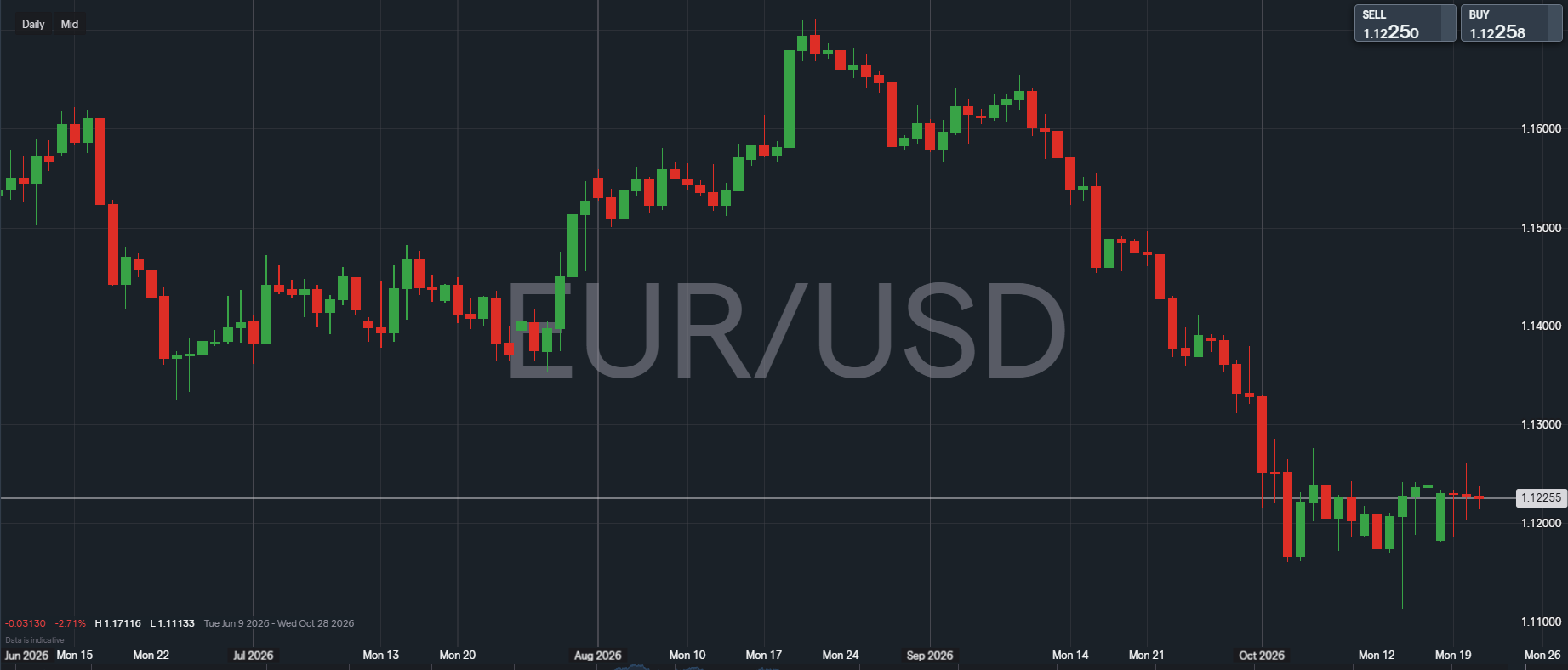
EUR/USD Daily Price History
That leaves the dollar in limbo ahead of a key stretch for global monetary policy. A meaningful shift in the geopolitical climate—particularly in the Middle East, and secondarily in the Russia-Ukraine conflict—could quickly change the outlook, as could a move in Treasury yields or a more hawkish turn from the Fed.
If global tensions intensify after the U.S. midterm elections, some of the recent support behind the dollar could return. On the other hand, if the geopolitical climate instead moderates, especially alongside softer policy expectations or lower yields, that support could begin to unwind.
The next round of central-bank decisions could help tip that balance.
The Fed and several other major central banks are expected to hold rates steady, while the Bank of England is currently expected to tighten in early November. That contrast—and the possibility that any of those decisions or accompanying guidance surprises the market—could quickly shift relative rate expectations, putting GBP/USD and the broader dollar outlook firmly in focus.
Why a Hot CPI Report Failed to Spark a Dollar Breakout
The inflation backdrop still looks uncomfortable for the Fed. September consumer prices rose 0.6% from the previous month and 3.7% from a year earlier, both above expectations, while core inflation increased 0.3% on the month and 2.6% year over year.
Other recent data have reinforced the same message. Producer prices jumped 1.3% in September—the largest monthly increase in roughly four and a half years—while retail sales rose 0.8%. Inflation remains stubborn, but consumer demand has yet to show the kind of weakness that would make the Fed’s job considerably easier.
Under different circumstances, that combination might have been enough to drive U.S. yields and the dollar decisively higher. This time, however, the data have not materially changed the near-term rate outlook. Markets still expect the Fed to leave rates unchanged on October 28, with another immediate hike remaining unlikely.
That disconnect helps explain the dollar’s recent price action. The U.S. Dollar Index (DXY) has traded between roughly 100.50 and 102.50 over the past month and currently sits near 101.75. That leaves it near the middle of its recent range, even after the hotter CPI report, and toward the upper end of its much wider one-year range of roughly 95 to 103.
The issue, then, is not whether inflation remains elevated. It is whether the next round of data is strong enough to push expectations meaningfully in one direction or the other. So far, it has not.
What Could Break the Dollar Out of Its Range?
For the dollar to regain momentum, traders may need to see a clearer shift in one of the forces currently holding the market in balance. That could come from the Fed, Treasury yields, or a meaningful change in the geopolitical climate—particularly in the Middle East.
The most obvious policy catalyst would be a change in the Fed outlook. A more hawkish message on October 28—or stronger evidence that another hike is coming in December, and possibly beyond—could push Treasury yields higher and give dollar bulls another reason to step in.
Alternatively, a more dovish outlook that pushes the next hike further into the future, or raises doubts about whether additional tightening is needed at all, could weigh on yields and push the U.S. Dollar Index back toward 100, or potentially lower.
But monetary policy is only part of the picture. The geopolitical backdrop has also contributed to the dollar’s recent strength, and a change in tenor could shift the outlook quickly. Renewed tension in the Middle East could increase safe-haven demand while putting renewed upward pressure on energy prices and inflation expectations—both potentially supportive of the dollar. A meaningful moderation in the conflict could work in the opposite direction.
That leaves the dollar exposed to catalysts from several directions just as the global policy calendar becomes unusually crowded. With major central banks preparing to announce decisions within days of one another—and the geopolitical backdrop still capable of shifting quickly—relative rate expectations, Treasury yields, and safe-haven flows could all change at once. That combination may ultimately provide the spark needed to push the dollar out of its October range.
What Markets Expect From Upcoming Central-Bank Meetings
The final week of October brings several major policy decisions in rapid succession, followed by a couple of other key announcements in early November.
- Federal Reserve (October 28): The Fed is widely expected to leave rates unchanged at 3.75%–4.00%, with CME FedWatch putting the probability near 85%. But with inflation still running hot, another hike remains a real possibility in December.
- Bank of Canada (October 28): The BoC is expected to keep rates at 2.25%. Recent weakness in the labor market has reduced the pressure to tighten again, and markets now see little chance of another hike before year-end.
- Reserve Bank of New Zealand (October 27-28): The RBNZ is one of the few major central banks still expected to raise rates this month. A 25-basis-point hike to 3.00% remains the leading call, although upcoming inflation data could still change that outlook.
- European Central Bank (October 29): The ECB is expected to hold at 2.50% after raising rates in September. But traders will be watching closely for any signal that another hike could follow in December.
- Bank of Japan (October 29-30): The BOJ is expected to hold at 1.25% following its September increase. Inflation remains elevated, however, keeping another hike later this year firmly on the table.
- Bank of England (November 5): The BoE is now expected to raise rates by 25 basis points to 4.00%. That marks a sharp shift from just a few weeks ago, when markets were still leaning toward no further tightening this year.
Key Levels to Watch Across the Major Currency Pairs
With the policy backdrop already in place, the next question is where the major currency pairs are trading—and which levels could come into play if expectations shift.
GBP/USD may be one of the more interesting pairs to watch, with the Bank of England currently expected to raise rates in early November. Here are the key levels and setups to watch across the major pairs:- EUR/USD: This pair currently trades near 1.1230, close to the bottom of its six-month range, between roughly 1.1160–1.1770. That makes 1.1160 a key downside level to monitor; while a clean break below that could put 1.1100 in play. To the upside, 1.1250 is the first hurdle, followed by 1.1300.
- USD/CAD: USD/CAD currently trades near 1.4037, toward the upper end of its roughly 1.3580–1.4280 six-month range. On the upside, 1.4100 remains the main level to watch. A reversal lower, meanwhile, would put the psychologically important 1.4000 level back in focus, with a clean break potentially opening the door to a broader pullback.
- USD/JPY: USD/JPY currently trades near 157.90, around the middle of its six-month range of roughly 153.50 to 164.00. From here, 158.50 is the main upside level to watch, while a move lower could bring 157 back into focus. USD/JPY can move sharply once momentum builds, so a clean break in either direction could quickly bring a wider range of levels into play.
- GBP/USD: Expectations for another Bank of England rate hike have helped lift sterling in recent days, with GBP/USD now trading near 1.3390, just below the midpoint of its roughly 1.3165–1.3650 six-month range. On the upside, 1.3460 looks like the first hurdle, followed by the psychologically important 1.3500 level. If the expected rate hike does not materialize—or momentum shifts for another reason—1.3300 would be the first downside level to monitor.
How to trade US dollar
- Open an account to get started, or practice on a demo account
- Choose your forex trading platform
- Open, monitor, and close positions on USD pairs
Trading forex requires an account with a forex provider like tastyfx. Many traders also watch major forex pairs like EUR/USD and USD/JPY for potential opportunities based on economic events such as inflation releases or interest rate decisions. Economic events can produce more volatility for forex pairs, which can mean greater potential profits and losses as risks can increase at these times.
You can help develop your forex trading strategies using resources like tastyfx’s YouTube channel. Our curated playlists can help you stay up to date on current markets and understanding key terms. Once your strategy is developed, you can follow the above steps to opening an account and getting started trading forex.
Your profit or loss is calculated according to your full position size. Leverage will magnify both your profits and losses. It’s important to manage your risks carefully as losses can exceed your deposit. Ensure you understand the risks and benefits associated with trading leveraged products before you start trading with them. Trade using money you’re comfortable losing. Past performance is not indicative of future results.