EUR/USD Steadies at 1.1000 as History Hints at a Bounce
EUR/USD steadied near 1.1000 after a five-day, 2% slide on Fed hike repricing and risk-off flows; history suggests a modest bounce may be in order.


EUR/USD steadied near 1.1000 on Tuesday after a bruising stretch for the single currency. The pair has shed roughly 2% since last Tuesday across five consecutive down closes. The U.S. Dollar has been the main beneficiary of a two-pronged move. Markets are repricing Federal Reserve expectations toward rate hikes, and a liquidity-centric flight to quality has taken hold as risk appetite deteriorated. That combination has given the greenback both a yield advantage and safe-haven demand.
The Euro, meanwhile, has had little to stand on. No meaningful domestic catalyst has emerged to offset the shift in U.S. rate expectations, leaving the single currency exposed. A Fed repricing toward tighter policy raises the relative appeal of holding dollars. When that coincides with a scramble for liquidity, the dollar’s role as the world’s primary funding currency tends to amplify the move. Until Eurozone data or ECB rhetoric gives the Euro a reason to push back, U.S. rate expectations and risk sentiment are likely to set the pair’s path.
EUR/USD Daily Price History
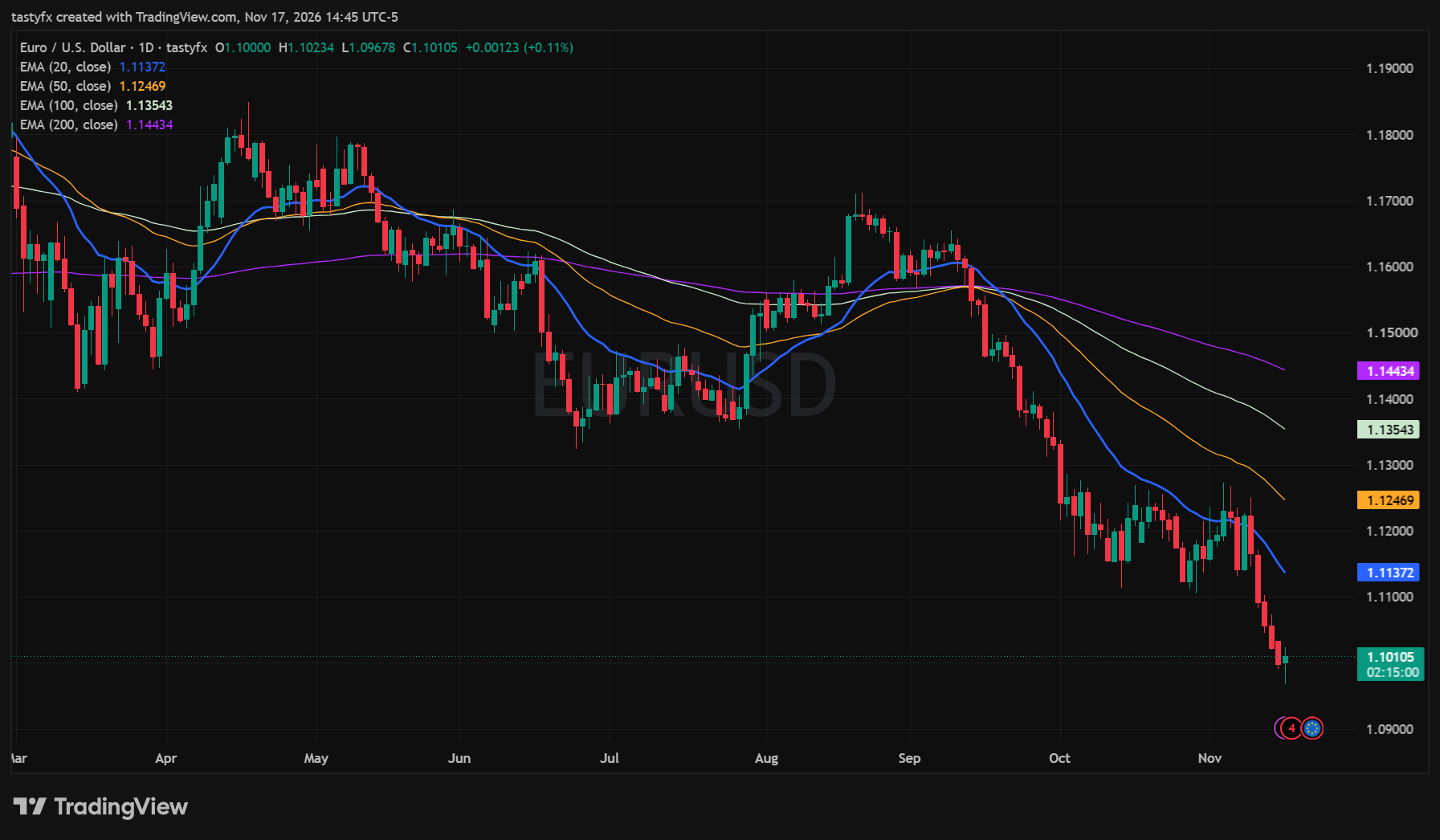
In the above chart, EUR/USD rates have stabilized around 1.1000, but the technical picture offers little conviction that the downtrend is ending. The pair remains below all of its key daily EMAs (exponential moving averages), with no bullish crossover in sight. Momentum has also yet to reach oversold territory, a sign that sellers have not necessarily exhausted themselves. Until the pair reclaims the EMA cluster overhead, today’s stabilization reads more like a pause than a reversal.
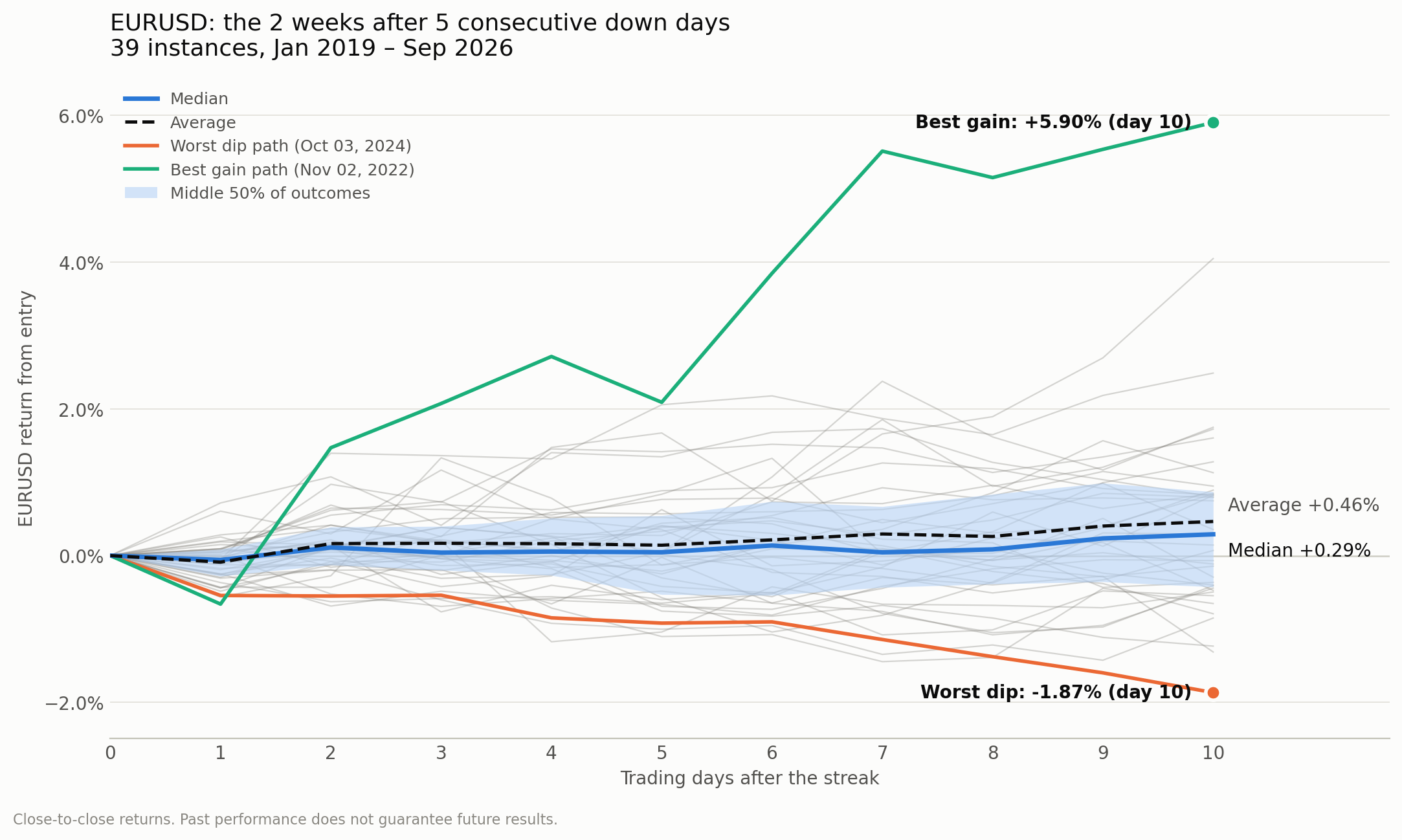
That said, history suggests the pair may be due for some relief. Since 2019, EUR/USD has posted five consecutive down closes on 40 separate occasions. Measured from the close of the fifth down day, the two-week (10 trading day) horizon stands out as the only one with a near-meaningful edge. Over that window, the pair gained an average of 0.46% (median 0.29%), and 56% of instances finished higher against a baseline of 48%. Returns at the one-week, one-month and three-month horizons proved less consistent. The largest two-week recovery came in 2022 at nearly 6%, but the typical outcome has been far more modest. In other words, the setup may warrant a small bounce rather than a trend change. There are several ways to approach it, but traders would be well-reminded not to get greedy. Past performance is not indicative of future results.
Trading forex requires an account with a forex provider like tastyfx. It’s important to manage your risks carefully as losses can exceed your deposit. Ensure you understand the risks and benefits associated with trading leveraged products before you start trading with them.